

Overwhelmed Founder? 7 Early Signs of Decision Burnout Most Founders Miss
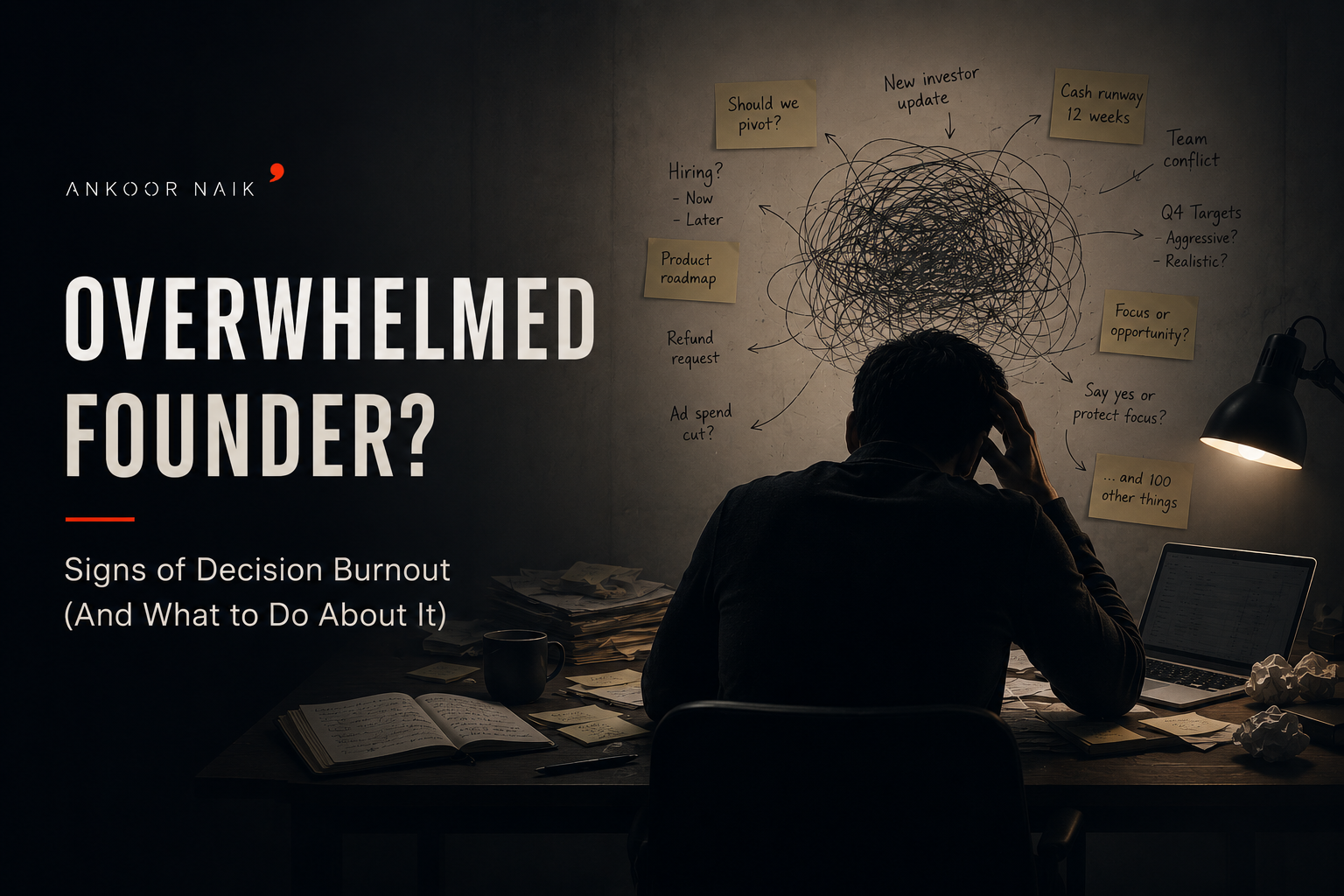
Many founders describe themselves as overwhelmed.
But what they are experiencing is rarely exhaustion.
They are still working.
Still showing up.
Still making progress.
From the outside, nothing looks broken.
Revenue may be growing.
The team may be expanding.
Momentum may still be visible.
Yet internally, something begins to feel different.
Decisions that used to feel clear now require more effort.
Small choices linger longer than they should.
Your mind stays active even when the workday ends.
Not because the company is failing.
But because the volume and weight of decisions have quietly crossed a threshold.
This is where many founders begin approaching what can be described as decision burnout.
Not emotional burnout.
Not loss of motivation.
And not the collapse that people typically associate with founder burnout.
Decision burnout is something more subtle.
It happens when sustained, high-stakes decision volume begins to erode clarity.
At first, the change is small.
You hesitate a little more.
You revisit choices more often.
You feel mentally busy even when nothing urgent is happening.
Most founders dismiss these signals.
They assume it’s simply part of leadership.
But these early shifts matter.
Because burnout rarely arrives suddenly.
It builds quietly — starting with the gradual erosion of decision clarity.
This article looks at the early warning signs founders often miss, while they are still functioning and performing — but moving closer to cognitive overload.
Recognising these signals early is what allows founders to reset decision clarity before deeper strain builds.
What “Decision Burnout” Really Means for Founders
When founders hear the word burnout, they often imagine something dramatic.
Exhaustion.
Loss of motivation.
Stepping away from the company.
But what many founders experience long before that point is something quieter.
Not emotional collapse.
Not physical exhaustion.
And not laziness.
What they experience is decision burnout.
Decision burnout is not about energy.
It is about cognitive overload.
Founders operate in environments where the number of decisions never truly stops.
Hiring decisions.
Product decisions.
Pricing decisions.
Strategic direction.
Team dynamics.
Investor conversations.
Many of these decisions are not routine.
They are high-stakes, ambiguous, and often irreversible.
Over time, the sheer volume of responsibility begins to accumulate.
Not in obvious ways — but in subtle shifts in how the mind processes choices.
Decisions start requiring more effort than they once did.
Mental friction increases.
Clarity becomes harder to access quickly.
This is what decision burnout looks like.
It is the gradual erosion of cognitive clarity caused by sustained, high-stakes decision load.
From the outside, founders often appear perfectly functional.
They are still leading meetings.
Still setting direction.
Still moving the company forward.
But internally, decision-making begins to feel heavier.
Not because the founder has become less capable.
But because the decision load has exceeded what the mind can process cleanly without structure.
Understanding this distinction matters.
Because if decision burnout is mistaken for emotional exhaustion, founders may focus only on rest.
And while rest can help temporarily, it does not address the underlying problem.
The real issue is not motivation.
It is decision clarity under sustained cognitive pressure.
And that is something founders can recognise — and correct — much earlier than they often realise.
Why Founders Miss the Early Signs of Decision Burnout
One reason decision burnout often goes unnoticed is that it rarely looks dramatic.
Founders do not suddenly stop working.
They do not immediately lose motivation.
And the company may still be moving forward.
In many cases, the founder continues performing at a high level. Meetings happen. Decisions are made. Momentum appears intact.
This is why the early signals are easy to dismiss.
For high-performing founders, overload often feels normal.
High Performers Learn to Normalize Overload
Most founders reach their position because they can operate under pressure.
They are comfortable navigating uncertainty and making difficult decisions quickly. Over time, this ability becomes part of their identity.
When decision load increases, the instinct is rarely to question it.
The instinct is to endure it.
What begins as temporary pressure gradually becomes the baseline — and because the founder is still functioning, nothing appears obviously wrong.
Endurance Is Often Mistaken for Clarity
Another reason decision burnout goes unnoticed is that founders often equate endurance with effectiveness.
If the company is still moving forward, the thinking goes: we’re handling it.
But endurance and clarity are not the same thing.
A founder can continue pushing through decisions while the quality of those decisions slowly declines. Choices take longer. Trade-offs become harder to evaluate. Mental friction quietly increases.
Yet because progress continues, the internal strain is rarely questioned.
External Success Can Hide Internal Strain
Startups often produce visible signals of success.
Funding announcements.
Customer growth.
Hiring milestones.
From the outside, the company may appear healthy and accelerating.
But internally, the founder may be carrying an increasingly heavy cognitive load.
When success is visible, there is even less reason to examine internal strain. Everything appears to be working — so the signals are ignored.
The “I’ll Rest Later” Logic
Many founders are also conditioned to postpone recovery.
They assume the pressure is temporary — something that will ease after the next milestone.
After the next funding round.
After the next launch.
After the next phase of growth.
But decision burnout rarely develops in a single moment.
It accumulates gradually through sustained decision pressure.
By the time the signals become obvious, the cognitive load is often already high.
Which is why recognizing the early indicators matters.
Decision burnout rarely begins with collapse.
It begins with small shifts in how decisions feel.
7 Signs You May Be Experiencing Decision Burnout
1. Decisions That Were Once Easy Now Feel Heavy
One of the earliest signals of decision burnout is a subtle increase in mental friction.
Decisions that used to feel straightforward begin requiring more effort.
Choices that once took minutes now linger longer than they should.
It is not that the decisions have become more complex.
The founder’s cognitive bandwidth has simply become saturated.
The mind is already processing dozens of unresolved variables — strategy, hiring, revenue, product direction, investor expectations.
Each additional decision now arrives in a system that is already full.
So even routine choices begin to feel heavier than they once did.
Not dramatically heavier.
Just enough that you notice the extra effort.
Many founders assume this means the stakes have increased.
Often, it simply means the decision load has quietly accumulated.
That shift — from ease to friction — is usually the first sign that clarity is beginning to erode.
2. You Delay Small Decisions but Obsess Over Big Ones
Another early signal of decision burnout is an imbalance in how attention is distributed.
Small decisions begin to stall.
Emails that require simple answers stay in drafts.
Minor approvals sit unresolved.
Routine choices that once took seconds now get postponed.
At the same time, the mind becomes increasingly occupied with larger decisions.
Strategic moves.
Hiring choices.
Market direction.
These bigger decisions start replaying repeatedly in the background.
The result is a strange contradiction.
Small decisions are delayed because the mind feels overloaded.
Yet large decisions occupy disproportionate mental space.
This pattern is not procrastination.
It is a sign that the brain is trying to conserve cognitive bandwidth.
When decision load becomes too high, the mind instinctively postpones low-priority choices while continuing to circle the most consequential ones.
Over time, this creates a backlog of unresolved small decisions — which only adds to the sense of mental congestion.
And that congestion is one of the clearest indicators that decision clarity is beginning to decline.
3. You Revisit Decisions You’ve Already Made
Another early signal of decision burnout is the tendency to mentally reopen decisions that were already resolved.
You make a choice.
You communicate it.
The team begins executing.
But internally, the mind keeps returning to the same question.
“Was that the right call?”
“Should we have waited?”
“Did we miss something?”
This does not necessarily mean the original decision was unclear.
More often, it reflects cognitive fatigue.
When decision load becomes high, the mind struggles to fully close loops.
Instead of moving cleanly from decision to execution, a small part of the brain continues reviewing alternatives.
Not constantly.
But often enough to be noticeable.
Over time, this creates a quiet pattern of mental re-litigation.
Choices that should feel settled begin feeling slightly unsettled.
The founder continues moving forward operationally, but mentally, the decision never feels fully closed.
That lingering doubt is not always about the decision itself.
It is often a sign that the decision system is overloaded.
And when too many decisions remain partially open, clarity begins to erode.
4. You Default to “Let’s Wait” More Often
As decision burnout begins to develop, another pattern often appears.
The default response to new decisions becomes:
“Let’s wait.”
At first, this feels responsible.
Waiting can be a legitimate strategy.
More information can improve decision quality.
But when cognitive load becomes high, waiting begins to serve a different purpose.
It reduces immediate pressure.
Instead of resolving the decision, it postpones it.
Founders may notice themselves saying:
“Let’s revisit this next week.”
“Let’s gather a bit more data.”
“Let’s think about it.”
Sometimes this is strategic patience.
But when it happens repeatedly, it can signal something else.
The mind is trying to avoid adding another decision to an already full system.
So postponement becomes a temporary relief valve.
The danger is that postponed decisions do not disappear.
They accumulate.
Over time, the backlog of unresolved choices increases the very pressure the founder was trying to reduce.
And the decision environment becomes even noisier.
This is why a growing habit of “let’s wait” can be one of the quieter indicators that decision capacity is nearing its limit.
5. You Feel Mentally Busy Even During Quiet Moments
One of the clearest signals of decision burnout is the inability for the mind to fully disengage.
Even when the day slows down, thinking does not.
A founder might be walking home, having dinner, or trying to rest — yet the mind continues running through fragments of unresolved decisions:
“Should we hire now or wait?”
“Was that product call premature?”
“Did I misread the investor conversation?”
None of these thoughts are necessarily urgent.
But they keep appearing.
This is different from productive reflection.
Healthy strategic thinking tends to be focused and temporary.
It begins with a question and ends with some form of resolution.
Decision burnout feels different.
The mind remains permanently active in the background, revisiting partial decisions, potential risks, and unfinished questions.
Over time, this constant cognitive activity drains mental energy.
Not because the founder is incapable of deciding.
But because the brain never receives a clear signal that thinking can stop.
When that signal disappears, even moments that should feel restorative continue carrying mental load.
And the founder begins to feel mentally busy even in silence.
6. Advice From Others Feels More Confusing Than Helpful
In the early stages of building a company, outside advice can be extremely valuable.
Mentors, investors, operators, and peers often provide perspectives that help founders see blind spots and refine decisions.
But when decision burnout begins to build, the relationship with advice can start to change.
Instead of bringing clarity, additional perspectives begin to create more noise.
Different people recommend different paths.
One investor suggests pushing growth harder.
Another recommends extending the runway.
A peer suggests pivoting.
A mentor advises patience.
None of these perspectives are necessarily wrong.
But when the founder’s internal clarity is already strained, the growing number of external viewpoints becomes harder to process.
Instead of sharpening the decision, each additional opinion introduces another possible direction.
The founder begins to feel less certain about their own judgment — not because they lack capability, but because the signal has become difficult to distinguish from the noise.
Advice that once felt helpful starts to feel overwhelming.
And when that happens, it often reflects not a problem with the advice itself, but a system that is already carrying too many unresolved decisions.
7. You’re Functioning — But With Less Conviction
One of the most subtle signs of decision burnout is that performance does not immediately collapse.
The founder continues to operate.
Meetings still happen.
Plans still move forward.
Decisions are still made.
From the outside, everything appears relatively normal.
But internally, something feels different.
Decisions that once felt clear now carry a small amount of lingering doubt.
Instead of feeling grounded after choosing a direction, the founder may feel only partially settled.
Execution continues, but conviction is weaker.
This doesn’t mean the decisions are necessarily wrong.
It simply means the cognitive system that supports decision-making is under strain.
And when that strain builds over time, founders often begin operating in a state where they are still capable — but no longer fully confident in their own judgment.
That shift is easy to ignore because work continues.
Yet it is often one of the earliest signals that the decision environment needs to be reset.
Decision Burnout vs Overthinking vs Founder Burnout
Because the symptoms can feel similar, founders sometimes confuse decision burnout with other forms of mental strain.
But these patterns are not the same.
Understanding the difference helps identify what actually needs to change.
Decision Burnout vs Overthinking
Overthinking usually appears as circular thinking loops.
The mind repeatedly revisits the same decision, searching for certainty or reassurance.
Questions replay internally:
“Did I miss something?”
“What if there’s a better option?”
“Should I revisit the decision?”
The issue in overthinking is mental looping.
Decision burnout is different.
The founder is not stuck on one decision.
They are carrying too many decisions at once.
The problem is not circular thinking — it is decision density.
Too many choices, arriving too frequently, each carrying consequences.
Decision Burnout vs Burnout
Burnout is a much broader collapse of energy.
When founders experience burnout, symptoms often include:
- persistent exhaustion
- emotional numbness
- loss of motivation
- difficulty engaging with work at all
Decision burnout appears earlier.
The founder is still functioning.
Work continues.
The company moves forward.
But the cognitive system responsible for making decisions begins to feel strained.
Clarity takes longer to arrive.
Confidence weakens.
Mental effort increases.
In many cases, decision burnout is one of the stages that precedes full burnout if the decision environment remains unchanged.
Recognizing it early allows founders to adjust how decisions are made — before deeper exhaustion develops.
Why Decision Burnout Becomes Dangerous If Ignored
Decision burnout rarely disrupts a company overnight.
The risk is more gradual.
Because founders continue functioning, the early signals are often dismissed as temporary fatigue or a demanding phase of the business.
But when the decision system remains under strain for long periods, several patterns tend to appear.
Decision Quality Begins to Erode
When mental capacity is stretched, decisions are more likely to be made under pressure rather than clarity.
Founders may begin:
- choosing the quickest path instead of the clearest one
- postponing difficult choices repeatedly
- relying more heavily on external opinions than their own judgment
Individually, none of these decisions appear catastrophic.
But over time, small compromises accumulate.
And the overall direction of the company becomes harder to steer with confidence.
Regret and Second-Guessing Increase
When decisions are made under cognitive fatigue, the mind often revisits them later.
Founders may begin replaying past decisions more frequently:
“Was that the right hire?”
“Should we have waited before launching?”
“Did we pivot too early?”
This second-guessing does not necessarily improve the decision.
Instead, it consumes additional mental energy that could have been directed toward forward movement.
Emotional Reactivity Starts to Rise
When cognitive load remains high, emotional resilience often declines.
Situations that once felt manageable can begin to trigger stronger reactions.
Small setbacks may feel larger.
Routine disagreements may feel heavier.
This does not mean the founder has become less capable.
It often means the mental system supporting judgment and composure is carrying too much unresolved pressure.
Burnout Risk Increases Over Time
Decision burnout itself is not the same as full burnout.
But when decision strain continues without adjustment, it can gradually lead there.
The founder continues operating under high responsibility while clarity steadily declines.
Eventually, the combined pressure of decisions, uncertainty, and cognitive fatigue becomes difficult to sustain.
Recognizing decision burnout early allows founders to adjust how decisions are made — before the strain reaches that stage.
How Mental Clarity Interrupts Decision Burnout Early
Decision burnout is not simply the result of making too many decisions.
It usually develops when the decision environment becomes noisy and unstructured.
When every decision feels equally urgent, equally important, and equally uncertain, the mind struggles to prioritize clearly.
Mental clarity helps restore structure to that environment.
Instead of reacting to every incoming decision, founders begin to distinguish between:
- signal and noise
- important decisions and routine ones
- choices that require reflection and choices that require momentum
When this distinction becomes clearer, the cognitive load of leadership begins to reduce.
Decisions become cleaner.
Some decisions are made quickly and closed.
Others receive deeper attention when needed.
But the constant background pressure begins to ease.
Mental clarity does not eliminate difficult decisions.
What it does is change how those decisions are experienced.
Instead of feeling like an endless stream of pressure, decisions begin to feel more contained.
And when decisions are contained properly, founders often regain the sense of conviction that leadership requires.
This is why many founders find that strengthening mental clarity does more than improve thinking.
It restores the conditions under which good decisions can be made consistently over time.
Final Thought: Burnout Rarely Arrives Suddenly — It Builds Quietly
Most founders do not wake up one day suddenly burned out.
The process is usually much quieter.
At first, decisions simply start feeling heavier.
Clarity takes a little longer to arrive.
Confidence becomes slightly harder to access.
Work continues.
The company keeps moving.
From the outside, nothing appears dramatically different.
But internally, the decision system is carrying more pressure than it used to.
Because founders are accustomed to operating under responsibility, these signals are easy to ignore. They often appear like a temporary phase of the business.
Yet over time, unresolved decision strain accumulates.
Recognizing decision burnout early allows founders to adjust how decisions are approached — before the pressure grows into something more difficult to reverse.
Leadership will always involve difficult choices.
But when the decision environment is structured well, those choices do not need to drain the clarity required to lead.
And in the long run, the founders who sustain their thinking best are rarely the ones who avoid hard decisions.
They are the ones who learn how to carry them without losing mental clarity.

Ankoor Naik
Follow - LinkedIn
