

One-to-One Coaching vs Generic Advice: What Actually Clears a Founder’s Head?
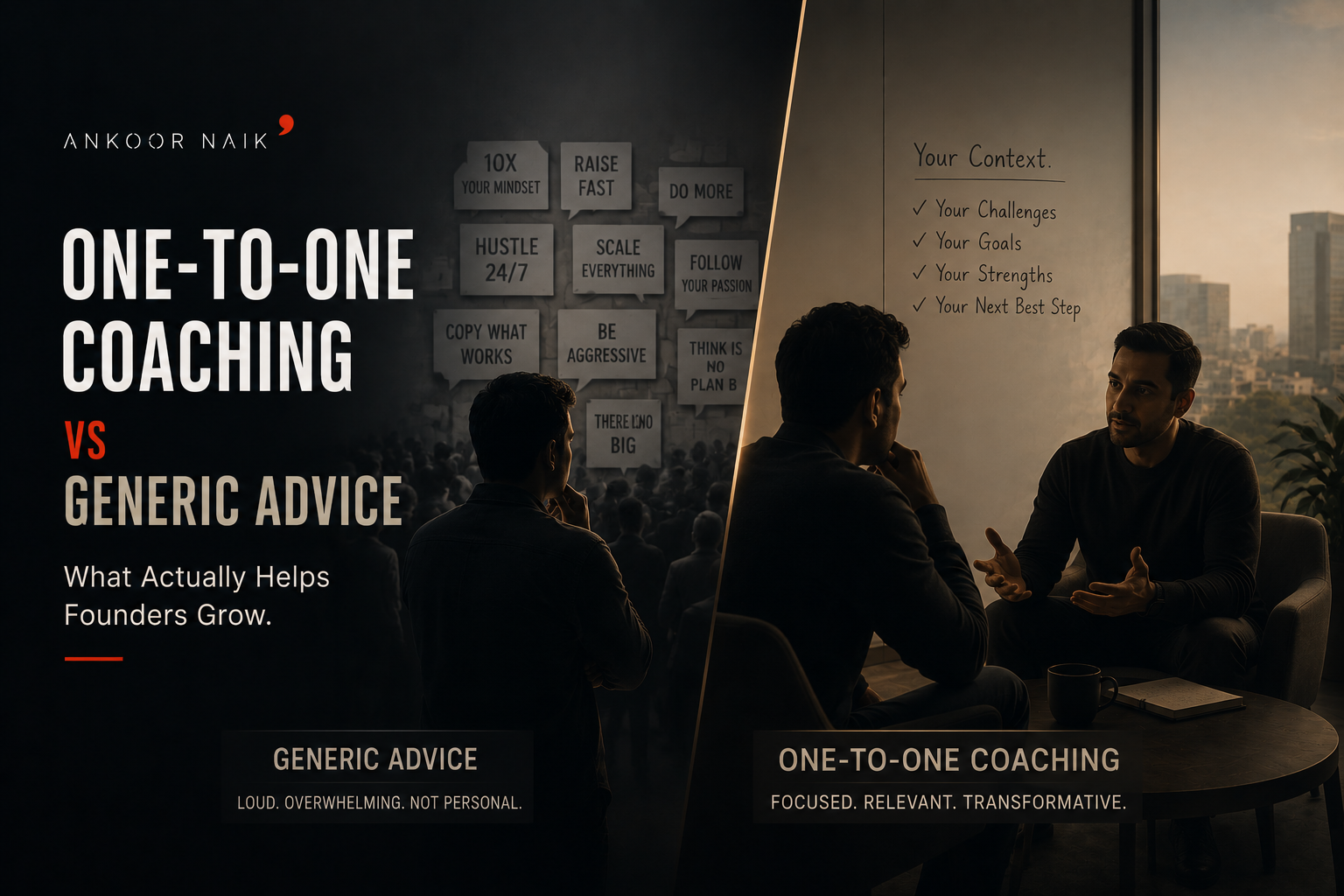
Most founders are not short of advice.
They’ve read the threads.
Listened to podcasts.
Spoken to other founders, investors, operators.
At any given point, there is always something to try.
A new way to think about growth.
A better framework for hiring.
A different approach to decision-making.
And yet, despite all of this input, something often doesn’t change.
Clarity.
Decisions still feel heavier than they should.
The same questions return in slightly different forms.
And even after taking action, the mind doesn’t feel settled.
This can be confusing—especially for founders who are doing everything “right.”
Seeking perspective.
Staying informed.
Learning continuously.
But more input does not always translate into clearer thinking.
In many cases, it does the opposite.
This article is not about dismissing advice or suggesting that founders should stop seeking it.
Advice has its place. So do conversations and shared experiences.
The real question is different.
Why does clarity remain out of reach—even when you’re surrounded by useful inputs?
And what actually changes when clarity begins to form?
Why Founders Consume More Advice When They Feel Less Clear
When clarity starts to drop, most founders don’t reduce input.
They increase it.
Not because they are confused about what to do next—
but because they are trying to feel more certain about it.
Advice, in these moments, acts as reassurance.
A conversation with another founder.
A perspective from an investor.
A framework that seems to fit the situation.
Each input creates a temporary sense of direction.
For a while, things feel clearer.
But that clarity rarely holds.
Because the underlying decision hasn’t been resolved—
it has only been supported externally.
So the cycle continues.
When uncertainty returns, more input follows.
More conversations.
More perspectives.
More ideas that seem useful in isolation.
Over time, this creates a subtle shift.
Founders begin to rely on external validation loops.
Not in an obvious way.
But in small, repeated patterns:
- Checking if others would make the same decision
- Looking for confirmation before moving forward
- Re-evaluating choices after hearing new inputs
None of this comes from lack of capability.
In fact, it often shows the opposite—
a founder who is thoughtful, open, and actively trying to make better decisions.
But somewhere in the process, information starts getting mistaken for clarity.
And the two are not the same.
Information expands what you can see.
Clarity determines what actually matters.
When the mind is already crowded, more information does not resolve uncertainty.
It increases the number of things competing for attention.
That is why even highly capable founders— operating in strong ecosystems, with access to good advice— can still feel stuck.
Not because they don’t know enough.
But because the system they are using to arrive at clarity is no longer working cleanly.
The Hidden Problem With Generic Advice for Founders
Advice, by itself, is not the problem.
In many cases, it is useful.
It exposes you to patterns.
It shows what has worked in other contexts.
It expands the range of possible decisions.
The issue is more subtle.
Generic advice is context-agnostic.
It assumes that the situation it came from
is close enough to the one you are in.
But for founders, that is rarely true.
Every decision sits inside a very specific reality:
- Stage of the company
- Team dynamics
- Capital constraints
- Personal risk tolerance
- Timing and market conditions
Advice does not carry that full context.
It carries an outcome.
A pattern.
A perspective shaped elsewhere.
So when founders try to apply it directly,
there is always a layer of mismatch.
Not enough to reject it completely.
But enough to create friction in decision-making.
There is another layer most advice does not account for.
Emotional ownership.
The weight of a decision does not come from the idea itself.
It comes from having to live with the consequences.
Advice can suggest a direction.
But it does not carry the responsibility of choosing it.
That responsibility stays with the founder.
And when multiple pieces of advice point in different directions,
the burden increases—not decreases.
Instead of clarity, the founder is left holding
several reasonable paths, each with its own logic.
Under pressure, this does not simplify thinking.
It complicates it.
Advice also behaves differently in high-noise environments.
When inputs are already high,
each additional perspective does not just add value—
it adds cognitive load.
More to consider.
More to evaluate.
More to reconcile.
Over time, everything begins to feel equally important.
And when everything feels important,
prioritization becomes harder.
This is the hidden problem.
Advice tells you what to do.
It rarely helps you decide what matters.
And without that distinction,
more advice does not lead to clearer decisions.
It leads to a more crowded mind.
What Founders Actually Need When Their Head Feels Full
When a founder’s head feels crowded, the instinct is to solve it with more input.
Another conversation.
Another perspective.
Another attempt to “figure it out.”
But the issue is rarely a lack of ideas.
It is the lack of space to process them cleanly.
At this point, what founders need begins to change.
Not more information.
But a different kind of environment for thinking.
1. Fewer Inputs, Not More
Clarity does not improve by increasing the volume of inputs.
It improves when the number of active signals reduces.
When fewer things are competing for attention,
the mind can actually process what already exists.
This is often uncomfortable.
Because reducing inputs can feel like stepping away from opportunity.
Or missing something important.
But in reality, it creates the conditions
for better decisions to form.
2. Decision Ownership, Not Validation
When clarity drops, founders often look for confirmation.
Someone to say,
“Yes, this makes sense.”
“This is the right move.”
But validation does not resolve uncertainty.
It only makes it temporarily easier to act.
What creates clarity is something else.
Decision ownership.
The ability to choose a direction
without needing external agreement to support it.
This does not mean ignoring input.
It means not depending on it to finalize judgment.
3. Space to Hear Their Own Judgment
In crowded environments, internal judgment gets quieter.
Not because it disappears.
But because it gets overridden by external signals.
Advice.
Opinions.
Comparisons.
Over time, it becomes harder to distinguish
what you actually think
from what you have recently heard.
Clarity requires that space back.
Not to isolate from the world—
but to allow internal thinking to surface fully
before being influenced again.
4. Someone Who Reflects Thinking, Not Opinions
Most conversations add perspective.
Very few create clarity.
Because they introduce new ideas
instead of helping process existing ones.
At a certain point, what founders need is not another opinion.
They need a way to see their own thinking more clearly.
To notice:
- What they are actually trying to solve
- What is influencing their judgment
- What is being avoided or overemphasized
This kind of reflection does not add noise.
It reduces it.
What One-to-One Coaching Does Differently (For Founders)
At this point, the question is not whether advice is useful.
It is why, despite access to good advice,
clarity still does not improve.
The difference is not in the quality of information.
It is in how decisions are processed.
This is where one-to-one coaching for founders
starts to operate differently.
Not by adding more input.
But by changing the way thinking is structured.
It Creates Context-Specific Clarity
Most advice operates at a general level.
It works on patterns.
What has worked before.
What tends to work in similar situations.
But decisions are never made at a general level.
They are made inside your specific context.
Your constraints.
Your team.
Your timing.
Your appetite for risk.
One-to-one coaching brings the focus back to that.
Instead of asking,
“What is the right thing to do?”
The question becomes,
“What is the right decision here, given your reality?”
This shift alone removes a large amount of friction.
Because clarity improves when decisions are evaluated
inside the context they actually belong to.
It Separates Signal From Emotional Noise
Not all confusion comes from lack of information.
A significant part of it comes from emotional noise.
Urgency.
Fear of making the wrong call.
Pressure to move quickly.
Ego attachment to certain outcomes.
These are rarely addressed in generic advice.
They sit underneath the decision,
quietly influencing how it is evaluated.
One-to-one coaching surfaces these layers.
Not to remove them completely—
but to make them visible.
Because once they are visible,
they stop operating unconsciously.
And when that happens,
it becomes easier to distinguish
what is actually signal
from what is being amplified by emotion.
It Forces Decision Ownership
Advice can be followed.
Coaching cannot be outsourced.
In a one-to-one coaching environment,
there is no external answer to adopt.
No conclusion handed over.
The founder is still the one making the decision.
But the process becomes clearer.
Assumptions are examined.
Trade-offs are made explicit.
Avoided questions are brought forward.
This naturally leads to stronger decision ownership.
Not as a principle.
But as an outcome of clearer thinking.
It Improves Thinking, Not Just Outcomes
Advice often focuses on outcomes.
What worked.
What delivered results.
What should be replicated.
Coaching focuses on something else.
How thinking happens before the outcome.
Because outcomes vary.
Context changes.
What works once may not work again.
But the ability to think clearly
is transferable across situations.
Over time, this compounds.
Decisions feel less forced.
Less dependent on external input.
Less reactive to changing signals.
This is why one-to-one coaching is not about
getting better answers.
It is about building a system
where clarity can form consistently.
Coaching vs Mentoring vs Advice: A Simple Comparison
At a surface level, these can look similar.
All three involve conversations.
All three can offer perspective.
All three are used by founders at different stages.
But they operate in fundamentally different ways.
Advice focuses on direction.
It tells you what to do based on what has worked elsewhere.
It is often quick, accessible, and useful in specific situations.
But it does not stay with the decision long enough
to account for your context or constraints.
Mentoring focuses on experience.
It draws from what someone has seen, built, or navigated before.
It can provide pattern recognition and long-term perspective.
But it still operates from the outside in—
applying learned experience to your situation.
Coaching focuses on thinking.
It does not begin with answers or past patterns.
It begins with how you are processing the decision itself.
Instead of adding direction,
it creates space to examine:
- What actually matters in this situation
- What is influencing your judgment
- What assumptions are shaping the decision
The goal is not to replace your thinking.
It is to make it clearer.
When One-to-One Coaching Is Most Useful for Founders
Not every situation requires coaching.
There are phases where decisions are straightforward.
Where context is clear.
Where execution matters more than reflection.
But there are also moments when thinking starts to loop.
The same question returns—
even after multiple conversations.
Different inputs point in different directions.
And despite movement, clarity does not improve.
These are usually the points where one-to-one coaching
becomes most useful.
Repeating Decision Loops
Some decisions do not get resolved in one sitting.
They come back.
Slightly reframed.
Influenced by new inputs.
But fundamentally the same.
Expand the team or stay lean.
Push growth or stabilize operations.
Move fast or reduce risk.
When the same decision keeps resurfacing,
it is often not a lack of options.
It is a lack of clean processing.
High-Stakes Trade-Offs
Certain decisions carry weight.
Not because they are complex—
but because the consequences are difficult to reverse.
Hiring senior leadership.
Changing strategic direction.
Letting go of something that has worked so far.
In these situations, more advice does not always help.
Because each perspective brings its own logic.
What founders need here is not more direction—
but a way to evaluate trade-offs clearly
within their own context.
(Also see: Founder’s Framework for Tough Decisions → internal link)
Runway Pressure
When time and capital are constrained,
decision-making changes.
Urgency increases.
Tolerance for uncertainty reduces.
Every choice begins to feel more critical.
This often leads to faster decisions—
but not necessarily clearer ones.
Under runway pressure,
mental space tends to shrink the most.
And without structure,
thinking becomes reactive.
(Also see: Runway Anxiety in Founders → internal link)
Team or Co-Founder Tension
Some of the most complex decisions
are not operational.
They are relational.
Differences in priorities.
Misalignment in expectations.
Unspoken concerns that influence decisions indirectly.
In these situations,
external advice rarely captures the full picture.
Because what needs to be processed
is not just the decision—
but the dynamics around it.
Loss of Internal Conviction
Perhaps the most subtle signal.
Nothing is visibly wrong.
The company is moving.
Decisions are being made.
But internally, something feels less stable.
Second-guessing increases.
Clarity feels inconsistent.
Confidence becomes dependent on external input.
This is often where founders realize
that the issue is not execution.
It is clarity.
Why Clarity Improves Faster Than Confidence
Confidence cannot be built directly.
It follows clarity.
When thinking is clean:
- Trade-offs are understood
- Assumptions are visible
- Decisions feel complete
Confidence built on external validation is unstable.
Clarity creates stability.
This is why mental clarity for founders becomes foundational.
(Explore more → Founder Mental Clarity pillar page)
Final Thought: Founders Don’t Need Better Answers — They Need Clearer Thinking
By the time founders question advice,
they have already tried applying it.
And yet, something doesn’t settle.
Not because the advice was wrong.
But because it never fully translated
into their own decision-making.
At some point, the search changes.
From finding answers
to understanding how to think clearly.
This is where one-to-one coaching starts to make sense.
Not as a source of answers.
But as a space to process thinking—
without additional noise.
For founders who feel stuck
despite consuming the right kind of advice,
one-to-one clarity coaching can help create
the space needed to think and decide cleanly.
No frameworks to follow.
No answers to adopt.
Just a way to return to your own judgment—
with more clarity than before.
FAQ
What is one-to-one coaching for founders?
One-to-one coaching for founders focuses on improving how decisions are made, not just what decisions to take. It creates clarity within the founder’s specific context.
Why doesn’t generic advice work for founders?
Because advice is context-agnostic. It does not account for your constraints, stage, or emotional ownership of decisions.
Is coaching better than mentoring?
They serve different purposes. Mentoring shares experience, while coaching sharpens thinking.

Ankoor Naik
Follow - LinkedIn
