

How to Stop Overthinking as a Founder (Without Slowing Growth)
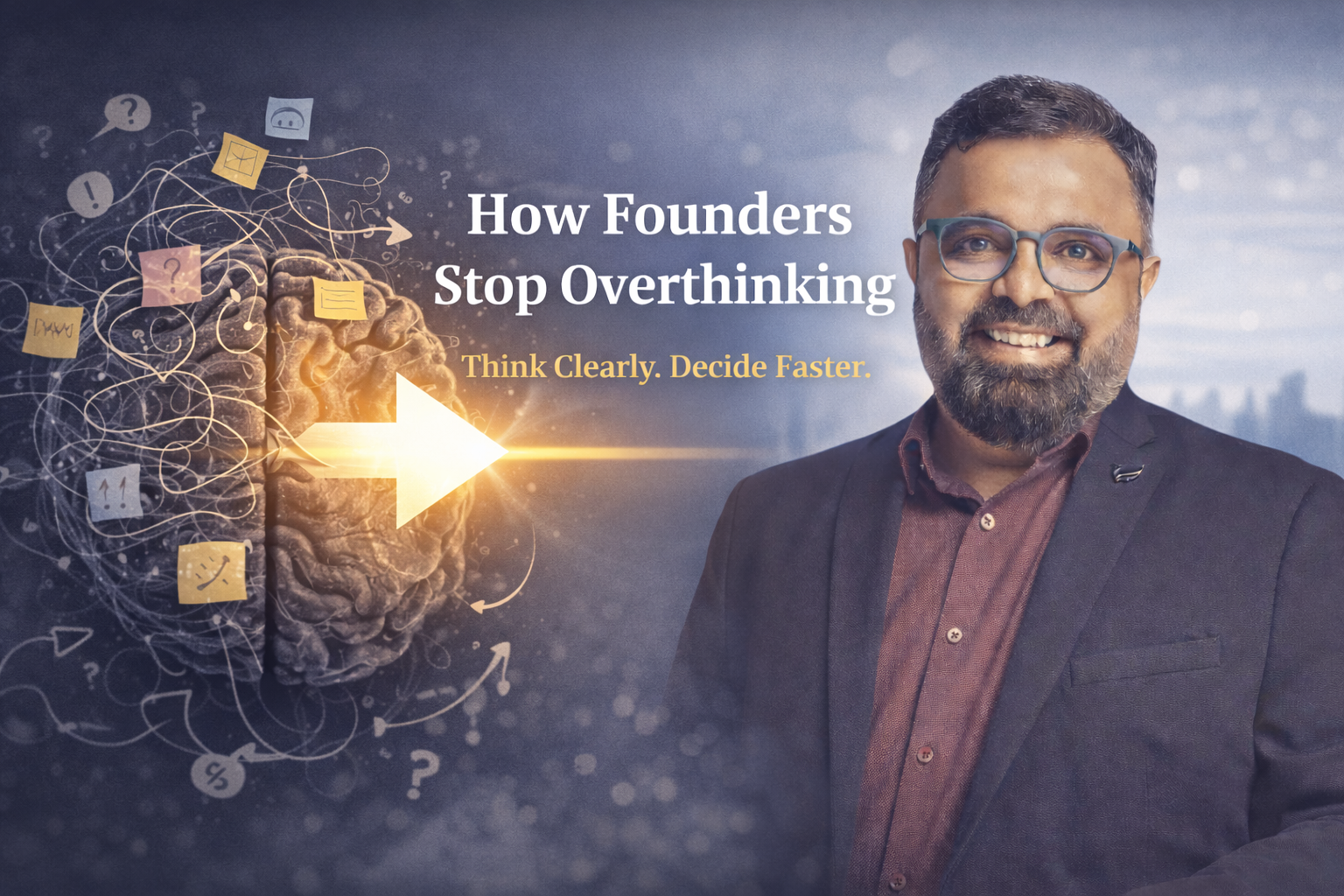
Most founders don’t describe themselves as “overthinkers.”
They describe themselves as responsible.
They think deeply because the stakes are real. Because decisions affect people, runway, reputation, and years of effort. Because being careless is not an option.
And yet, somewhere along the way, thinking starts to turn against them.
Decisions take longer than they should. The same questions loop in the mind late at night. Conversations are replayed, rewritten, re-argued internally. Even after a choice is made, the mind keeps checking: Was that right? Did I miss something? Should I revisit it?
From the outside, nothing looks broken.
From the inside, the mental noise never fully quiets.
This isn’t a lack of confidence.
It isn’t poor decision-making ability.
And it isn’t a productivity problem.
It’s overthinking — not as a flaw, but as a by-product of sustained responsibility without enough mental closure.
Many founders experience this as constant overthinking, mental fatigue, or decision exhaustion — without realising what’s driving it.
For founders, overthinking doesn’t come from caring too little.
It comes from caring a lot — without having a clean way to release the pressure that builds after decisions are made.
This page isn’t about stopping thought.
It’s about restoring clarity, so thinking works for you again — without slowing growth, lowering standards, or disengaging from the company.
What This Page Will (and Won’t) Help You Do
This page is not productivity advice.
It won’t give you decision frameworks, performance systems, or routines to optimise your day. It’s not about thinking faster, working harder, or becoming more disciplined.
It’s also not therapy, emotional processing, or mindset motivation. The goal here isn’t to “feel better” or reframe everything positively.
What this page is about is mental closure.
It’s about understanding why a capable founder’s mind stays active long after decisions are made — and what actually helps the mind release pressure without disengaging from responsibility.
This page is designed for founders who are still functioning, still growing, and still making decisions — but feel that thinking has become heavier, noisier, or harder to switch off than it used to be.
If that resonates, everything that follows will make sense.
Overthinking Is Not the Problem — It’s the Signal
Most founders try to eliminate overthinking.
They want the noise to stop. The looping to quiet down. The second-guessing to disappear.
But overthinking itself isn’t the real problem.
It’s the signal that something underneath hasn’t been properly contained.
In founder contexts, the mind overthinks when it’s carrying unresolved responsibility — not when it lacks confidence or competence.
Overthinking is what happens when:
- Decisions are made, but not fully integrated
- Emotional reactions are felt, but not acknowledged
- Responsibility keeps increasing, but mental space doesn’t
The mind keeps working because it doesn’t know it’s safe to stop.
Until this is understood clearly, founders either:
- Fight their own thinking
- Try to suppress it
- Or blame themselves for not being “decisive enough”
None of that works for long.
To understand how overthinking actually forms — and why it’s so common among capable founders — we need to look at the conditions that create it.
Why Overthinking Is So Common Among Founders
Founders rarely start overthinking because something is wrong.
They start overthinking because responsibility increases faster than the mind’s ability to process it cleanly.
As the company grows, the number of variables expands:
- People
- Money
- Reputation
- Dependencies
- Consequences
At first, founders can hold all of this mentally.
Later, they’re still holding it — but without noticing the strain.
Overthinking doesn’t arrive as confusion.
It arrives as continuous partial attention.
The mind never fully closes one loop before opening the next.
Overthinking isn’t random. It has patterns — especially in founders.
It tends to show up when three conditions overlap:
1. Decisions carry long-term consequences
Founder decisions are rarely reversible in clean ways. Hiring, firing, strategy shifts, exits, cofounder dynamics — even “small” choices echo forward. The mind keeps scanning for downstream risk long after the decision is technically done.
2. Emotional reactions are suppressed, not processed
Founders often feel they must stay composed. Doubt, frustration, resentment, fear — these emotions are acknowledged briefly (if at all) and then pushed aside to keep moving. But unprocessed emotion doesn’t disappear. It resurfaces as mental looping.
3. There’s no clear endpoint for thinking
In early stages, speed matters. In growth stages, correctness matters. Over time, founders lose a clear signal for when a decision is complete. The mind stays “open,” constantly revisiting, refining, second-guessing — not because it’s useful, but because there’s no internal closure.
This is why telling founders to “just decide faster” or “trust yourself more” doesn’t help.
They already decide.
They already care.
They already carry responsibility.
What’s missing isn’t effort or discipline.
What’s missing is a way to contain thinking so it doesn’t leak into every quiet moment.
Overthinking, in this context, isn't a weakness.
It's an uncontained cognitive load.
And unless that load is addressed properly, founders don’t stop overthinking — they just learn to live with it, at a growing cost to energy, conviction, and emotional bandwidth.
Overthinking vs Strategic Thinking: The Difference Most Founders Miss
The confusion between overthinking and strategic thinking is one of the biggest reasons founders stay stuck longer than necessary.
Both involve analysis. Both involve care. Both can look identical from the outside.
But internally, they produce opposite effects: one reduces pressure, the other multiplies it.
Founders often assume overthinking is just “thinking deeply.”
It isn’t.
Strategic thinking moves a decision toward resolution.
Overthinking keeps a decision cognitively and emotionally unfinished.
The difference isn’t intelligence or effort. It’s containment.
Strategic thinking:
- Explores options, then lands
- Accepts trade-offs once they’re chosen
- Leaves the mind quieter after a decision
Overthinking:
- Re-examines the same variables repeatedly
- Replays conversations instead of resolving them
- Keeps scanning for risk even after a choice is made
From the outside, both can look like diligence.
Internally, they feel very different.
Strategic thinking feels effortful but grounded.
Overthinking feels busy, unresolved, and mentally draining.
Most founders don’t struggle because they think too much.
They struggle because thinking never gets closure.
And when thinking has no clear endpoint, it spills into evenings, weekends, and quiet moments—long after the decision itself should be made.
How Overthinking Actually Shows Up in a Founder’s Life
Overthinking doesn’t always feel dramatic.
For most founders, it doesn’t arrive as panic or visible anxiety. It shows up quietly, woven into the normal rhythm of work.
For many founders, overthinking doesn’t feel like too many thoughts.
It feels like unfinished business living rent-free in the mind.
Nothing is actively wrong.
Nothing is urgently broken.
Yet the mind keeps returning to the same edges — not to solve them, but to stay prepared.
This is why overthinking often intensifies during calm periods.
When meetings end.
When the inbox clears.
When the external noise drops.
The mind fills the silence with what hasn’t been resolved internally.
Decisions get made — but they don’t feel finished.
Conversations end — but they continue internally.
Even when progress is real, the mind stays alert, scanning for what might have been missed.
From the outside, this looks like diligence.
From the inside, it feels like the inability to mentally rest inside your own decisions.
One of the most common signs is decisions that linger longer than they should.
This lingering isn’t indecision — it’s unresolved ownership.
Not because the decision was wrong — but because it never fully “lands.” The mind keeps returning to it, reopening trade-offs, replaying alternative paths, searching for certainty that no longer exists.
Another pattern is mental replay after interactions.
A board conversation. A cofounder discussion. A tense team exchange. Long after the moment has passed, the mind re-runs it — rephrasing sentences, imagining better responses, wondering how it landed. Not to improve communication, but because something emotionally unresolved remains.
Overthinking also shows up as difficulty switching off, even when work pauses.
The body may slow down, but the mind doesn’t follow. Quiet moments don’t feel restorative — they feel filled. Thinking continues not because there’s urgency, but because there’s no clear signal that it’s safe to stop.
Many founders notice a subtle shift here:
Clarity comes briefly — after a good conversation, a walk, or a moment of insight — and then slowly dissolves. Within hours or days, the mental noise returns. The mind fills the space again, not with chaos, but with constant low-level processing.
There’s also a subtle identity shift that happens.
Founders begin trusting motion more than clarity.
Doing something feels safer than sitting with uncertainty — even when that uncertainty deserves space.
Over time, urgency starts replacing conviction.
Decisions are made faster, not because they’re clearer, but because the pressure to move forward outweighs the discomfort of uncertainty. Action becomes a way to quiet the mind — temporarily.
None of this means the founder is indecisive.
In fact, many founders experiencing overthinking are highly capable decision-makers. The issue isn’t making decisions. It’s carrying them — emotionally and cognitively — without closure.
This is why overthinking feels exhausting in a specific way.
It’s not intense enough to be labelled burnout.
It’s not emotional enough to be called anxiety.
It’s not visible enough to trigger concern from others.
It’s simply a mind that stays “open” for too long — holding responsibility without release.
And unless that state is understood clearly, founders don’t stop overthinking.
They adapt to it.
They normalize it.
They carry it forward — until clarity starts costing more than it should.
Why Common Advice Fails Founders Who Overthink
Most advice about overthinking is designed for people who have excess thought — not excess responsibility.
Founders don’t overthink because they lack structure.
They overthink because they’re carrying decisions that don’t have clean emotional or cognitive endpoints.
Advice that ignores this difference misses the mark — even when it sounds reasonable.
When founders talk about overthinking, the advice they receive is usually well-intentioned — and mostly unhelpful.
They’re told to trust themselves more.
To move faster.
To journal.
To meditate.
To optimise decision frameworks.
To build better systems.
Some of this advice works — briefly. But it rarely addresses the root of the problem.
The issue isn’t that founders don’t know how to think.
It’s that they’re thinking without a way to contain the weight of what they’re carrying.
Productivity advice assumes the problem is inefficiency.
Mindset advice assumes the problem is confidence.
Performance advice assumes the problem is discipline.
For founders who overthink, none of these are accurate.
Most founders already operate at a high level of discipline.
They already make decisions under uncertainty.
They already reflect — sometimes too much.
What these approaches miss is that overthinking is not a skill issue.
It’s a capacity issue.
Capacity isn’t fixed.
But it is finite.
And when capacity is exceeded, the mind doesn’t slow down — it compensates by staying alert.
This explains why founders feel constantly “on.”
When the mind is overloaded, adding more tools doesn’t create clarity — it adds friction.
Frameworks become another thing to evaluate.
Instead of creating relief, they increase self-monitoring.
This keeps the critique crisp and grounded.
Routines become another standard to maintain.
Advice becomes another voice in an already crowded mental space.
This is why telling founders to “decide faster” often backfires.
Speed doesn’t reduce overthinking — it just pushes unresolved pressure forward. The mind keeps looping, now with higher stakes attached to rushed decisions.
It’s also why meditation or reflection practices don’t always land.
Without structure, reflection turns into rumination. Instead of creating space, it amplifies unresolved thoughts.
Even confidence-based advice — “trust your instincts” — can miss the mark.
Founders don’t struggle because they don’t trust themselves.
They struggle because their mind doesn’t know when it’s safe to stop evaluating.
Overthinking persists not because founders lack clarity —
but because clarity doesn’t last.
The mental state most founders are in isn’t confusion.
It’s continuous partial processing.
Thoughts are started but not closed.
Decisions are made but not integrated.
Emotions are felt but not fully metabolised.
As a result, the mind keeps working — not because it needs to, but because it hasn’t been given an endpoint.
This is why the solution to overthinking isn’t thinking less.
It’s creating mental closure — cleanly, deliberately, and repeatedly.
Until that happens, even the best advice will feel like something to do, not something that actually quiets the mind.
What Actually Stops Overthinking (Without Lowering Standards)
What founders usually want is fewer thoughts.
What they actually need is a mind that knows when it’s done.
Overthinking doesn’t mean the mind is malfunctioning.
It means the mind is still doing its job — because it hasn’t been told it can stop.
Clarity isn’t created by force.
It’s created by completion.
Overthinking doesn’t stop when founders care less.
It stops when the mind learns that it’s done with a decision.
Most founders assume that once a choice is made, the thinking should naturally settle. When it doesn’t, they blame themselves — for lacking confidence, discipline, or decisiveness.
But the mind doesn’t work on intention alone.
It works on completion signals.
A decision that hasn’t been fully processed — emotionally and cognitively — remains open in the background. The mind keeps returning to it not because something is wrong, but because something is unfinished.
This is why overthinking persists even after action is taken.
Stopping overthinking isn’t about suppressing thought.
It’s about giving the mind what it needs to release pressure.
For founders, that usually means three things.
1. Clear Decision Boundaries
Many founder decisions are made under ambiguous conditions — partial information, conflicting inputs, time pressure. The decision is executed, but the criteria that justified it are never made explicit.
So the mind keeps revisiting the choice, searching for certainty that was never defined in the first place.
Clarity comes when founders can say:
- This was decided based on these constraints
- These risks were consciously accepted
- This was the best decision available at the time
Not as a rationalisation — but as a closure statement.
When decision boundaries are explicit, the mind stops re-litigating the past.
Without boundaries, every past decision stays mentally “appealable.”
2. Emotional Acknowledgement (Not Analysis)
Founders often move past emotional reactions too quickly.
Disappointment, frustration, fear, resentment — these are noticed briefly and then overridden in the name of progress.
But emotion that isn’t acknowledged doesn’t disappear.
It converts into mental looping.
Overthinking is often an emotion looking for recognition — not explanation.
Until the emotion is acknowledged, the mind keeps thinking on its behalf.
This doesn’t require therapy language or emotional deep-dives. It requires something simpler and harder:
- Naming what was felt
- Allowing it to exist without justification
- Letting it pass without being acted on
When emotion is acknowledged, the mind no longer needs to keep circling it.
3. A Clean End to Thinking
Most founders never consciously end their thinking.
They move on to the next task, the next conversation, the next decision — carrying unfinished cognitive threads with them.
Clarity returns when thinking is intentionally closed.
That closure can sound like:
- This decision is complete unless new information emerges
- Revisiting this without new data is not useful
- This thought does not need more attention right now
This isn’t denial.
It’s containment.
Containment is what allows high-performing founders to stay clear without staying mentally vigilant.
The mind calms when it knows it doesn’t have to stay alert.
Overthinking stops not because founders become less thoughtful —
but because thinking becomes bounded.
Why Overthinking Gets Worse as Companies Grow
Ironically, overthinking often increases with success.
As companies scale, decisions carry broader impact. Teams depend on them. Reversibility decreases. Public perception matters more. Mistakes become costlier — socially, financially, emotionally.
So founders adapt by keeping the mind “on” all the time.
This constant mental vigilance often gets mistaken for leadership seriousness.
Founders start believing that if their mind is always active, they’re being responsible.
If they relax mentally, something might slip.
If they stop evaluating, they might miss risk.
But leadership maturity isn’t constant monitoring.
It’s knowing what deserves attention — and what no longer does.
Clarity isn’t passive.
It’s selective.
Over time:
- Confidence erodes, not because decisions are wrong, but because certainty is never allowed to settle
- Intuition weakens because the signal is buried under evaluation
- Rest feels unproductive because the mind never fully powers down
At this stage, founders often confuse overthinking with leadership maturity.
What actually looks like depth is often unresolved pressure.
Maturity isn’t constant analysis.
It’s knowing when to stop.
The Real Cost of Living With Overthinking
Overthinking rarely causes immediate breakdown.
Its damage is slow and quiet.
It shows up as:
- Reduced conviction in meetings
- Emotional distance from decisions you once felt clear about
- Mental exhaustion disguised as professionalism
- Difficulty enjoying progress because the mind is already scanning the next risk
The cost isn’t that founders become ineffective.
It’s that they stop feeling settled inside their own leadership.
Progress continues.
Results happen.
But internally, decisions no longer feel clean.
That’s when clarity stops being a “nice to have” and starts becoming essential.
Most founders don’t seek help because of overthinking alone.
They seek it when they realise they haven’t felt mentally settled in a long time.
Not burnt out.
Not disengaged.
Just never fully at ease with their own thinking.
That’s the signal.
A Final Note for Founders Reading This
If overthinking has become familiar, it doesn’t mean you’re failing.
It means you’re carrying weight — often silently.
The goal isn’t to think less.
It’s to think cleanly, then rest.
Clarity doesn’t come from effort.
It comes from resolution.
And once the mind learns how to resolve, it no longer needs to stay loud to protect you.
Clarity isn’t about controlling outcomes — it’s about being at peace with how you choose.

Ankoor Naik
Follow - LinkedIn
